Thursday, March 25, 2010

Define: Alchemy


"An Alchemist in his Workshop" by David the Younger Teniers

This week's assignment: to blog about what "alchemy" is.

Well, at first I thought I would search the internet for relevant videos and articles on the subject of alchemy, but a simple google search on multiple variations of this theme seemed useless. I was flooded with images with "healing properties", doomsday prophecies set to pictures, and historical presentations on how alchemy has been perceived throughout the ages. In the field of art, I came across countless images like the one above depicting an elderly scholar surrounded by the clutter, often with an apprentice of some sort, attempting to achieve some transformative power.

None of these images or ideas seemed to align with the idea of alchemy as we discussed it and as I believe it to be in relation to ourselves and our world. Alchemy, simply said, is the power to transform. It is the quest to control one's environment, the quest to control and transform the self. When one thinks about the stereotypical idea of turning lead into gold, one must think of it as a simple metaphor. This is what we must do for ourselves....as an action and a process. We must transform the low-brow into the high-brow, and I think that is the goal of this class. How do we move from the state of lead, of demotic language, to a state of gold, into the realm and language of the gods?

I think the vital difference between an "alchemist" as Coelho would define him and the average man is the mentality of control and observation. We often become restricted by our surroundings, believing the illusion we have been born into, illusions such as place and specific identity. Without going into the "soul of the world" and "personal legends", I think it is safe to say that the process by which we break out of these restrictions or limitations is the process by which we become, rather than passive observers in our lives, truly active, engaged, and creative controllers of our own selves. Call it a transformation of soul, call it a hero's journey, the process remains the same. It is the shift of values, the shift between worlds by a P2C2E, the waking up to our simulation and the act of revelation. This is "alchemy," the active recognition and taking part in a process of realization and transformation.

Wednesday, March 24, 2010

The Throwing of Books

This semester seems to be one of book throwing. Now, I know for English majors, the very idea of hurling a book across the room at full speed and considerable force seems reprehensible, even an act of sacrilege. But I confess! I have committed this blasphemy several times this semester. I think the first book that I threw across my living room was that of Finnegan's Wake. I was frustrated with a language that wasn't language and yet all language. I was frustrated at not being able to read. In conventional terms. I don't really blame myself for that one though; Sexson warned us this might happen.

Next, I threw Beckett.....lovingly. I had just read a particularly mundane passage in Molloy and frustratingly let the book fall to the floor with a satisfying thud. The important thing about Beckett though, is that I picked it back up. And I loved reading Malone Dies.

After throwing a Shakespearean play the other day (I'm beginning to detect a trend: This class is bleeding into others) after muddling through its lengthy introduction, I picked up The Alchemist. Mere hours later, I had the unmistakable feeling that this would follow the others. Turning the pages with restrained vehemence, I voiced my opinions to my sister and roommate. She had already laughed at me when, without provocation, I had thrown the book I was reading previously at least four feet to a clatter of pages on the floor. Now she laughed again. I'm glad I was some sort of amusement for her, at least. =)

I didn't like The Alchemist because it didn't engage me. It read like a self-help book with talk of "Personal Legends" and the "Soul of the World" etc. I noticed that after each revelation that Coelho presented, the narrative voice would change to describe in great detail how the boy now believed this, was certain of that. It seemed to me that Coelho presented the idea and then took the reader, embodied in the boy, and told that reader "you belieeeeeve me......you belieeeeeve", like a sorceror or a simple trickster whose trick was all too evident. Without a doubt, the greater themes of definitions of place and of dreams are of vital importance in anyone's life. Truly, we can often only know a place by leaving it, or at least by having a mentality that allows one to distance oneself from attachment and self-limitation. However, in the Alchemist I feel this theme is diluted or diffused even as it is staring me in the face like a brick wall. Is there anything wrong with wanting to find the truth for oneself, in wanting a book to engage me and entrap me like, say, a Nabokov novel??

I suppose I have become spoiled by a semester of reading Nabokov. I want to be so engaged in the details and their relation to the whole, grand master scheme that I almost physically cannot put the book down. I want to know there is something more beneath the surface, something tangible and concrete, even if that "reality" is an illusion as well. I am quite content to peel back the layers of one of his novels incessantly. As horrifying as it is to say this, I simply don't feel that connection or sense of being vividly engaged with the material this semester. Perhaps this is due to the fact that the low-brow is too obvious to be compelling, and the high-brow, such as Finnegans Wake, is like a fearsome giant looming over me. I have no weapons. I feel the works of Nabokov are every bit as difficult and meaningful, if not more so, than what we are reading.

I'm frustrated and wondering, why do I feel the constant need to throw something at the nearest wall?? I think Beckett may be my saving grace in the end, but only because Malone Dies gripped me. I simply don't know what to do about the throwing of books. Quite frankly, I don't think they can take much more abuse. =)

Thursday, March 11, 2010

A Three Hour Tour =)

When presented with the idea of having three hours to live and the question of what to do with one's remaining time, the temptation is always to say dangerous...life-affirming things we usually would not do. "I would go skydiving, mountain-climbing....(fill in your favorite extremely dangerous activity here....)". Others seek to treasure what they know to be great and that they already have, the simplest pleasures of life we often take for granted. "I would spend time with my loved ones, finally finish that book, watch a sunrise". The reality is that most of us would probably waste our remaining moments in this world by freaking out about our imminent doom and striving to prevent it.

For me, I would like to believe that I could face the discovery of my soon-to-be end with some measure of strength. I like to believe that if it came to that, life would be sweeter to me, even more than it already is, more vivid. Even now, as I have no idea when my end (beginning??) will be, I have a sense of taking everything into myself. I used to be obsessed with the idea of capturing all the....beauty....the value of this world in art. My personal revelation came with the knowledge that one never truly captures that vision (of the intrinsic value of all things), one can never....really equate it. One can only come close. This fact disturbed me greatly because I was forced to confront the impermanence of even that immortality......immortality....framed?...in impermanence? I discovered that I did not have to capture it. I could let it move through me.


Now I don't mean to channel here any eccentric notions of energy travel or "flow"...though I will not be the one to discount these theories either. It was, rather, a certain process. I would be struck by something....the exact light of a tree-branch lit by a street lamp....the quality of the sound of a single drop falling from an icicle into a mud puddle...the divinely infinite reflection of the sky on a street wet from recent rains. Rather than seek to capture it, memorize it, assimilate that vision into myself, I would identify it. I would give it the time and the attention it deserved in that moment, and having paid that spark what it was owed, I let it go. I let it move away from me, accepting that the exact shade of the sky or the exact feeling of recognition between strangers for instance would be lost......but.....not altogether lost. I had lost the need for containment, limited definition perhaps. Call it what you will.


I would hope that my last three hours on earth would be spent with this experience or a similar one--only the beauty and richness of that experience would transcend even itself. I would hope that my time would be spent....living....because I consider this...underlying value and beauty, the framework that underlies our menial existence, I consider this to be....life.

The Storm


Continuing with the cave theme, here are some images from the cave of Les Trois Freres. The first is a description of the set of drawings as a whole. The figures overlap each other, move into one another and with one another in a swirl of activity. This abundance of action in the scene echoes the storm in the tempest, (no, I don't mean the physical storm...remember this is all an illusion). I am speaking of the storm of illusion, make-believe, and deception wrought by the magician figure in the book, Prospero. The second image in the three I have posted, is a detail of one figure in the mix, and is said to be a shaman figure with the power to shift into the mind of an animal, assume its physical shape, etc. See how the figure's hands and feet are human rather than animalistic in order to depict this synthesis. The third and final image is a hybrid of man and beast yet again and is described as a lesser sorceror with a musical bow. This figure seems to parallel Ariel whose powers in the art of deception enable Prospero to enact his own magic. The musical connection between the two can be seen here as well.
What The Tempest describes for us is the idea of submitting oneselves to be voluntarily deceived. We adopt "matrices" and other illusions, immersing ourselves in art and literature in order to achieve our own immortality to be sure. But there is another element to this willing participation in a cycle of lies and passing dreams. Why do we go out to see movies, the most literal version of the images played for prisoners in Plato's "Allegory of the Cave"? Why write great literature and subject ourselves to the ongoing struggle of differentiating or synthesizing art and immediate life? Why believe the lie, once we know it is a lie? In essence, "what's the point of stories when they aren't even true"? I feel this is a major theme presented in this class, and one that deserves our prolongued attention. Why make art? This is a question that has endured since the very conception of art, as can be seen in cave painting such as these.
There is a power there, in the deception. What strikes me time and again is the idea that we gain insight about ourselves and our world through deception. Through gates of deception, illusion, and falsehoods do we find what we call truth. Yet there is an aspect of the unveiling that must not be forgotten. Perhaps it is not the falsehood that captures us but the revelation, the epiphane achieved only through art rather than direct experience. How is this sort of revelation different than that achieved through one's own interactions with the world through physical means? Which is more valid? Can we even speak in those terms?
In this article on the caves at Lascaux, these ideas of creation, the dream, and surrogate versions of "reality" are explored in more detail. It reads fairly quickly and, I believe, raises interesting topics for discussion. Here are a few excerpts from the article:
"What is interesting about these creations is that they were the forerunners of the symbolic and sensory realm of art, drama and literature, which has become increasingly elaborate with the progress of civilization. Each in a different way, has allowed humanity to escape the literalness of its surroundings, to raise our collective noses off the ground, as it were, and produce a vision of other ways of living and other possible worlds, which are enough like this world to seem plausible."
"cave painters and their descendents had to journey inside them, and leave the rest of the world behind. The images were lit by flickering lamps, which must have added to the sense that they were in a world apart, a world modeled after their own fears and desires, and perceptions. [. . .] (and are) an expression of our desire to escape into seemingly human worlds, made lifelike through the application of art and technology, in which the landscape is that of the imagination."
"Today, as we increasingly live inside lifelike fictions, and re-create our surroundings as an endless form of immersive fiction, one has to wonder what will become of human nature. Will it change, as well, or will we end up reenacting the same things our ancestors did, but in increasingly spectacular forms?"
In this last paragraph, we see the emergence of the theme of eternal recurrence. The goal, then is to relive each cycle in greater splendor then the last, to be more, reach for more, to really "know a place for the first time". Perhaps we must also know ourselves anew. This is the key. We need to be like Miranda in that we view the world with fresh eyes in every moment. We must be aware of the cycle, be aware of the illusion (self-created or imposed on us i.e. the Matrix) yet still retain our transformative powers as creators....whether this be transforming the self or transforming one's own sphere of influence however large that may be. This is the vital importance of Miranda to the storm. We must incorporate into ourselves each of the powers here represented in order to "release them from their bands with the help of our good hands". From Caliban, we gain natural powers, from Miranda this sense of wonder and revelation, from books the power to transfrom; the list goes on. What role do we play on this stage on which we are "merely players". Are we then to become Prospero, master of our own illusion? I leave the answering of this question to my reader.

Friday, March 5, 2010

The Caves at Lascaux: Lasting Significance

Today in class, Dr. Sexson spoke of the cave in The Tempest in relation to the caves at Lascaux, France.

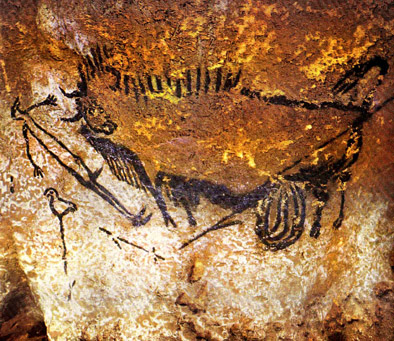
According to the Wikipedia article on the caves, they were first discovered in 1940 by four teenagers and have been deteriorating ever since due to the overabundance of visitors to the site. A second set of caves were created in 1983 with replicas of the paintings in order to preserve the original artwork. The paintings date back thousands of years to the paleolithic era. One of the most enigmatic images is this one, wherein a man with a bird head lies prostrate next to what appears to be a large bison. There is of course the mysterious bird on a stick in the same frame.

Theories as to the meaning of this piece are varied, and debate continues as to its actual meaning. Some say the narrative is that of the hunt or of a ceremonial ritual relating to the hunt. Others theorize that the three figures represent stars and that the entire cave system is a map of the skies. In this interpretation, the three figures represent the three stars, Vega, Deneb, and Altair. Together, these three make up the Summer triangle as illustrated in the above diagram. The mythological significance of these three in relation to the constellations to which they belong is referenced in the hyperlink to their names. Some say that through this gateway, one can travel to new realms of consciousness. In Chinese mythology, however, there is another myth relating to the three in the story of the Herd-Boy and the Weaver-Girl. To sum up the full story (see hyperlink) the herd-boy stumbles upon seven immortal maidens who have come to earth to bathe in a stream. Parallels can be drawn here to the nine muses. The herd boy , seeing the youngest of the maidens, falls in love and steals her clothes so that she cannot return to the heaven. The article states, "She must marry him after he sees her unclothed, as was the local quaint custom of the time." Here, we can draw parallels to Ovid's telling of Diana and Actaeon. The theme of vital importance here is the witnessing of some secret ritual, the initiation of the unknowing.

The story continues when his wife must return to her work in the heavens and the lovers are separated. The boy sneaks into heaven to see her by hiding himself in the skin of a water buffalo, but the two are separated again by a great river (the milky way). Here we have a great river, the river of dream? (The river of everything in the world, Finnegan's Wake??) Eventually, it is agreed that the couple can meet on the seventh night of the seventh month but only if the river is small so that the birds can form a bridge for the two to be together.

Regardless of any mythological significance, or perhaps in relation to it, the three stand as a gateway to higher consciousness. (See the Matrix and Plato's Allegory of the Cave). Dr. Felicitas Goodman theorizes that this depiction of the bird-man is the depiction of the shaman indulging in a "trance state". She says he is on a "spirit journey to the upper world". This article, explains the relation of the Lascaux images to her work on Trance Postures as a whole. Goodman theorizes that by adopting different postures depicted in multiple works of ancient art, one can achieve an altered state and transcend the physical. By doing this, one gains higher realization and interacts with a realm of existence we earthly bound know nothing about. More on her work on trance can be found here.

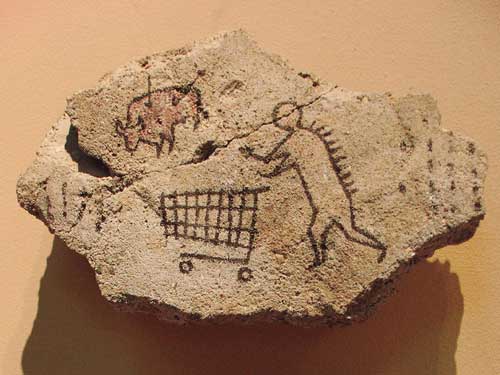
The tradition of cave painting for social commentary and further exploration of our world continues to this day through graffiti artists. One such artist is the infamous Banksy. I have included several of his more pertinent images below. Through artists such as these stretching back in time to the earliest man, we find our way through the caves of memory to infinite truths.

Thursday, March 4, 2010

Plato's "Allegory"

The other day in class, Dr. Sexson showed us a diagram of Plato's "Allegory of The Cave" which he thought was less than satisfactory. As the resident artist of the class, I've redrawn it. Now, I sketched this out very quickly, so go easy on me. =)

The prisoners of the cave are chained to the wall. They can only see the projection of the puppeteers behind them and therefore believe this projection is real. One prisoner, having escaped his chains, makes his way up to another world to witness the true sun with delight and amazement.


The allegory forces us to question the nature of our existence and of illusion. What we know to be real may in fact be the product of another's imagination. "Little do we know," there may be puppeteers or even a narrative voice behind even the most mundane things we do....we simply haven't heard it yet.


Tuesday, March 2, 2010

Life as Dream

Sometimes while surfing the web for themes in this class, I stumble on hidden gems. Today, I found a play, La Vida es Sueño (or Life is a Dream) by the celebrated Spanish author Pedro Calderón de la Barca. This play analyzes the idea of life as illusion or dream throughout. This dilemma is brought to a breaking point in one speech delivered in prison by the main character, Sigismundo. Several sources state that this speech is the "To be or not to be" of Spanish literature:

"I dream that I am here/ of these imprisonments charged, / and I dreamed that in another state/ happier I saw myself. / What is life? A frenzy. / What is life? An illusion, / A shadow, a fiction, / And the greatest profit is small; / For all of life is a dream, / And dreams are nothing but dreams"

Here, the main character questions the very fact of his existence. Perhaps this is all a vivid dream? If so, what happens when we wake up? If this is true, then what happens when we finally hear the narrator, summing up our own actions??